Blog by Robert (Bob) Wewer FSI Restorations
http://fourseasonsroofingandsiding.com/Roofing-Blog/index.php
My name is Robert Wewer
but people call me Bob.
Here is my company home page:
FSI Restorations
I live near Philadelphia, Pa and work as a Problem Solver
at FSI Restorations.
]]>Storm Damage in the Northeast Advice to Homeowners
http://fourseasonsroofingandsiding.com/Roofing-Blog/index.php?entry=entry130806-001858
In the event of storm damage, contact your insurance carrier immediately for coverage authorization. Take pictures to document the damage. If you must have temporary tarping installed, make sure you receive authorization from your insurance carrier if you expect them to pay for the emergency service.
Finding the right contractor may require prudent examination and researsh on your part. Often and with many contractors, there is a waiting period before actual work can be started. With a storm like this, there is an imperative to get things "buttoned-up" as soon as possible. This is the time when stop gap measures should be in place as noted above. Having temporary cover also allows you to obtain bids from three contractors and evaluate the documents.
Naturally, there will be differences in the written documents. A professional contractor will have provided a detailed proposal for the work to be done. Also look carefully for clauses regarding additional work, rotting wood, etc. Change orders are a normal part of dealing with contractors, but beware of any contractor that hides or omits items that later can be charged with a change order.
Professionalism is key in making your choice. Look forr it in the initial response and wether the contractor was late for the initial appointment. Interview the representative form the contracting company. Do not reveal what the "other guy said" to the subsequent arrivals. Give it three appointments and if you are not happy, go for more. Not everyone in the business is an expert, contrary to popular opinion.
Get a contractor that routinely work on rooftops and siding. There are several types of roofing so if it is a slate roof that you have, get a slate roofer. If it is a metal roof, get a metal roofer. Just because a guy shows up with a ladder does not make him an expert. If structural repairs are needed, make sure you have a contractor that can handle these issues. A full service contractor is usually better for severe damage, rather than a "one trick pony" of which there are many in the industry.
If there is water of mold issues, keep in mind that with common restoration companies, initial remediation is the focus and further rectification is either left to others or to subcontractors. It is when it gets involved that restoration should be the focus.
Complete restoration of your home or business to original condition, or better than original condition should be the focus. Getting everything done at once by one party is always better. There is no finger pointing if there is a problem later, things go smoother and one responsible contractor is always better than several on a given job.]]>Fly Ash Trim - The Answer to Exterior Trim
http://fourseasonsroofingandsiding.com/Roofing-Blog/index.php?entry=entry130730-153350
The 70% recycled product is made of Fly Ash which is a byproduct of coal burning. The supply of the raw materials is legend and the products are immune to water, rot, mold and insect infestation. Painting is simple without special priming and dark colors can be used without fear of warping from heat. Cutting, shaping and fastening is the same as wood. The look is the same as wood.
The lack of significant thermal movement is the greatest benefit over PVC. No longer are scarf joints and spacing necessary. These are truly the finest trim products ever introduced and the price is like that of wood.
by Bob Wewer
Fly Ash Trim Benefits by Bob Wewer]]>Gladwyne Roof Repair Services
http://fourseasonsroofingandsiding.com/Roofing-Blog/index.php?entry=entry130317-191747
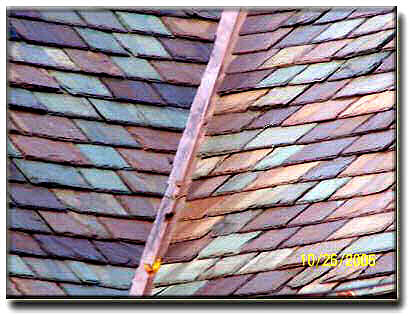
Roof Repair in Gladwyne requires the absolute proficiency in various old world techniques and abilities. All too often we see the work of novices in many of our trades. Natural roofing like that of Slate, Tile, Cedar, Metal and the like require abilities rarely fostered in the new age asphalt shingle and low slope marketplace. When a painfully under-skilled roofer endeavors to repair the natural roofing mentioned, the result is often destruction and higher end result costs to properly repair. Call a professional at FSI Restoration for a no-hassle report on your roof.
]]>Philadelphia Window Replacement Contractor Company
http://fourseasonsroofingandsiding.com/Roofing-Blog/index.php?entry=entry121015-193446
Have you recently contacted a window replacement company in Philadelphia, or the surrounding area and been run through the wringer by a high pressure salesperson?
If you have, you must realize that when the pressure is utilized on a prospective client, it is actually a sign of weakness on the part of the salesperson. The high pressure tactics are covering weaknesses in the company represented.
We advocate the gutting of the existing opening, if at all possible. The modern "Pop-In" replacements often leave homeowners upset because original rough openings are no addressed with appropriate insulation measures. The cold perimeter is a result in the winter months and in the summer, air conditioning is wasted on the uninsulated perimeters of the windows and doors.]]>Philadelphia Cool Roof Project
http://fourseasonsroofingandsiding.com/Roofing-Blog/index.php?entry=entry120804-210250
Philadelphia "Cool Roof" Project. Save on energy bills. Protect your roof and make it last longer. ]]>Roof Repair Philadelphia
http://fourseasonsroofingandsiding.com/Roofing-Blog/index.php?entry=entry120511-234500
Roof Repair in Philadelphia and the surrounding areas is an occupation which encompasses a myriad of skill-sets for the many styles and types of roofing in the Delaware Valley. The steep sloped roofing category has in itself Slate, Tile, Cedar and Asphalt shingles and several types of Metal Roofing which rely upon a given amount of pitch and layering for watershed into gutters. Low sloped roofing category consists of sealed systems of the Built-Up variety of Coal Tar Pitch and Asphalt Bitumen, the single and multiple ply systems of Modified Bitumens and single ply systems of EPDM & TPO as well as a few other systems which are in the minority.
Every type of roofing, other than the ladder and common tools needed for service, requires different procedures and equipment to render lasting repair. Experience in management of a roofing company is essential for the facilitation of proper repair of all types of roofing.
Usually a roofing company that services our area is more proficient in one area of roofing or another. The first and main distinguishing factor in proficiency in types of roofing is in that of the category of either steep or low sloped systems. In these two categories, while several methods are similar, methodology, materials and approach differ significantly.
Many years of experience are required to handle the marketplace of full service roofing repair in Philadelphia. FSI Restorations has over three decades of experience in all facets of the roofing industry and the company's skilled artisans can repair any roof and at any slope or height in the area. ]]>Roof Coating Philadelphia
http://fourseasonsroofingandsiding.com/Roofing-Blog/index.php?entry=entry120420-132925
WE DO ROW HOMES. Click here for a ROOF COATING ESTIMATE in PHILADELPHIA Commercial Roofing in the Philadelphia area is much like it is anywhere in the country. The prudent property manager and property owner will have the rooftop periodically revisited to ensure that all is well up top. Service is essential especially on low sloped roofs because as they age they lose valuable viscosity and become dry.
Whether the subject roof is rubber, plastic, asphalt or coal tar pitch, the enemy is the sun. The sun's ultraviolet rays will dry a rooftop and render it useless if the roof is not serviced. On many low sloped roofs the vertical parapet flashing details will go before the field. This is usually because single ply of lesser quality roof flashing material was used on the walls. The walls do not require the formidably necessary on the low sloped field. The wall flashings can degrade before the field, leaving the walls unprotected to leak down and under the field plies. This can cause a roof to fail. Simple repairs can avert all of the usual reasons for premature roof failure.
Many times when a roof is warranted for a period of time, its life can be extended to double of that warranty with the proper servicing of the rooftop. Even dried-out rooftops can be brought back into service with new elastomeric coatings available to the industry. Roof coating in Philadelphia is a thriving business as it is relatively inexpensive and it represents true value.
We service commercial roofs in the Philadelphia area with an arsenal of products that extend the life cycle of low sloped roofs while saving our clients on their energy bills. ]]>Jenkintown Slate Roofing Repair
http://fourseasonsroofingandsiding.com/Roofing-Blog/index.php?entry=entry120301-132315
Slate Roof Repair Jenkintown, Pa
Jenkintown Slate-Tile-Cedar-Tin-Copper Roofing
Specialty trade work such as natural roofing are rapidly becoming lost arts. The roofing industry has been inundated with fast-patch artists that endeavor to make a fast buck rather than to restore natural roofing. The results are very telling when the value of a property is diminished and restoration costs are increased by the shoddy repairmen of the roofing industry. ]]>Mold Remediation Philadelphia
http://fourseasonsroofingandsiding.com/Roofing-Blog/index.php?entry=entry111014-175838
Above is a petri dish sample of the HVAC system (taken at the register).
In my travels over the (33) years and in witnessing just about every type of mold infestation, one call was an educational experience for me. I thought I would share some of what I learned in this adventure.
I was called upon for mold remediation services for a large home in Bucks County, Pa. This home is impressive in its upgrades especially for the consistency with which its thoughtful owners kept with the theme of an old 1800's barn. It reportedly took a fourth architect to finally embrace the desired theme of the completed home. Despite a very clean and mostly dry environment, mold had taken hold.
This impressive home, as I learned after three trips to the residence, has been totally rebuilt except for the old stone walls, which were left standing. The structure was a run-down residence where the elderly lady inhabiting the old structure had reportedly let it go. The roof and all the floors were rebuilt with the open style architecture showing impressive barn timbers. The stone walls were re-pointed and left exposed. The new walls are drywall with a plaster overlay with an exclusive and antique wax treatment. The home is impressive to say the least. My job was to locate the source of mold that was literally threatening the health of the occupants.
The man of the house reportedly has pituitary gland shutdown, which reportedly affects much of the hormonal levels of the his body. My client, having his father die of Alzheimer’s Disease was fortunate enough to find a doctor that looked beyond blood deficiencies to root cause of his problems. It turned out that this man of 49 years of age was headed for Alzheimer’s Disease himself and an early an miserable death, if not for this doctor that looked beyond hormone replenishment to an underlying cause of his condition.
His wife relayed to me an interesting finding of this special doctor, that her husband has an inability to fight mold toxins and that this problem is genetic. The most interesting part of this story is that the doctor claims that every Alzheimer’s patient he treats has this same condition. The mold connection has reportedly been made! The claim is that this doctor has actually brought back a 94 year old Alzheimer’s patient to a more normal life. I was keen on hearing this information as having lost my mother at age 13, when she was only 44 years of age, to liver cancer, which has now been attributed to mold in improperly dried grain. My mom also lost her sister to the same disease who died a couple years earlier and at the same age.
So you may wonder, “Why such a discussion,” when mold in an old farmhouse is the focus. The reason for this to reflect the potential severity black mold presents and as you will read, the unique case this old home represents. In my quest to find the cause of the mold, I did the usual inspection of the basement, attic, ventilation and surrounding terrain and gutter system of the home. I found issues, but none that were contributing to the living area musty smell.
I performed an HVAC mold test for mold spores. After several days, the presence of mold was evident in the culture medium. Meanwhile my client was getting his tests back that verified the mold toxins in his blood. At this point, we knew that there was mold but it remained invisible to me. Only through much conversation with my client and my third trip out to the home, could we diagnose the unique root cause and location of the infestation. I usually look for the moisture issue, as do most Mold Remediators. The food resides just about everywhere in residential dwellings so the food often takes a back seat to moisture that often causes the mold problem.
It seems that this old home had many bats and the elderly lady inhabitant of the original structure fostered these pests, supplying bat houses and ignoring their take-over of her home. The home was previously infested with bats and the guano was a big problem and one of the reasons the home was totally gutted by its new owners. It was this fact that took us to the cause of the mold problem.
In reliving the construction and restoration of the home, my client told me of an incident that stuck in her mind while the roof was being installed. The roofers were on the roof working when one of the men leaned on the chimney for a moment of respite. As he looked into the chimney, he was startled and he screamed, “Bats!” The chimney reportedly was lined with the fur of living bats!
Now we had the source! The intake vents for the HVAC system were adjacent to the several chimneys on the first floor. Other than an unrelated infestation in the finished basement area, the first floor had a mold problem with a hidden cause and no visible active mold. The food for the mold was not the norm, but bat guano! Holy Bat Guano in the chimneys! Even though the chimneys had been cleaned, the jagged edges and ledges could never be 100% clean of the bat droppings. Mold, not being selective, will grow on just about any carbon or cellulose available to the organism. The wind carries the spores right down to the first floor and into the HVAC system. Moisture had been particularly available as recent hurricane Irene and subsequent storms had dumped over 20 inches of rain in the area.
So my educational experience of the week was very enlightening. Mold causes serious health issues and it grows where you least expect it. Sometimes it takes a little investigation to find the cause, but if we can get to it, we can kill it!
Cedar Acid Rots and Deteriorates Copper ]]>Fiber Cement Siding Shrinking on the Wall
http://fourseasonsroofingandsiding.com/Roofing-Blog/index.php?entry=entry100303-212243
We can only say that the products that have the gapping problems or curing on the wall, as we call it, have two possible red flag, tell-tale signs of potential problems. Look for either two of these issues and then run away from the product:
1. A single pass “press” system to level off the material in the manufacturing process.
2. Manufacturer will not allow “back-priming” of product, meaning a full bath or total all-side coating is not allowed and will void warranty. (This seems to be a red-flag as the product must be left uncoated on one side to continue curing after being nailed to the wall.) ]]>So what is GREEN anyway? Another excerpt from the book....
http://fourseasonsroofingandsiding.com/Roofing-Blog/index.php?entry=entry100226-234105
There are even approval processes that a company must endeavor to complete to be approved as a “Green Contractor.” All this just muddies the waters of the true meaning of Green. Similar to the municipal recycling business, where evidence of a truly confused system has been established to validate a government rebate system in these United States of America, where the end result is not 100% recycling. The almighty dollar rules at every turn. In some areas, brown paper, newspapers, cans and bottles are recycled. Some areas, paper is not recycled because a threshold is reached at just the bottles and cans. I have seen it as I have traveled the roads of the northeast.
It is hard not to develop a cynical outlook at what is a lie being perpetrated on the American public. Once, I remember, somewhere in NY State, a massive and rewarding recycling program by school children was tarnished by the lie. An award was being given out complete with luminaries and media present for the filling of dumpsters of cans and associated debris for recycling.
A couple of the enterprising media types followed the dumpsters as they were carted away to the landfill! Yes, the landfill! It was cheaper just to dump the debris than to return it into the manufacturing process. The almighty dollar rules over good judgment. This book will not only endeavor to explain common mistakes made in my industry, but to fight back against the “dollar rules” attitude in home improvements.
A 300 million dollar plus industry, the home improvement money spent is wasted in large part by the consumer. Most of this waste is caused by the “fast food” mentality of the day. We all want it now and we want it right and we want it at an affordable price. All of these elements are subjective, however the metaphor listed above regarding the slap at the children’s efforts at recycling is a slap you should not want for your efforts to improve your home. ]]>How do manufacturers influence the marketplace: Another excerpt from the book
http://fourseasonsroofingandsiding.com/Roofing-Blog/index.php?entry=entry100225-131740
Manufacturers Push Methodology; Trade Shows, and the “Knowledgeable” Consumer
The small home improvement businesses within the service industry have an increasing level of burden to meet governmental obligations, insurance costs, recycling and taxation mandates. With all of the increased governmental oversight, the building code stays much the same, and the officials, many times are really not as diligent as they could be in affording consumers more security of a job done right. Much of the problem is that the building officials are of low pay and the municipal governments derive an income from the issuance of building permits. Profit, all too often seems to be the motive of the municipal building departments. The exterior trades are often viewed as “minor work” and rightfully so, however, the building codes are often deficient and will refer to “manufacturer recommendations” in absence of real specificity in the building code.
Enter the manufacturer for the specifications and you have potential for self-serving recommendations. This can be seen in the rise of the underlayment and house-wrap sales that have captured much attention and consumer dollars over the past two decades. These topics are explored later in this book.
The manufacturers in this marketplace are to be blamed for being undereducated. Factory or manufacturer representatives are extremely underpaid, turnover is great, and the corporate hierarchy is conveniently kept at a distance. Factory warranties usually are only as good as the support from the contractor and the buying power of that contractor, which equals clout, which can get a consumer the attention needed for action from the manufacturer. What seems like good manufacturer coverage initially, under more scrutiny, resembles something more like Swiss cheese for all the holes and caveats contained to protect the manufacturer. Workmanship is often blamed for most problems that arise.
Manufacturers have employed various approaches to educate the public. This education, however, comes in the form of a sales pitch. The most effective was an approach started in the late 70’s and used by Certainteed, Corp., manufacturer of roofing and siding materials. Certainteed, especially with roofing, endeavored to educate the contractor on how to sell more profitable jobs by educating consumers on a good, better, and best approach. Certainteed also educated contractors that showed the effort at certification, the causes of job failures and ways to install a lasting job. Certainteed engaged the services of a third party consultant, with real and practical knowledge, which forged a better and more valid process that really helped the industry to a better reputation.
All manufacturers of roofing materials use an enhanced warranty system that includes extra underlayment measures and contractor certifications for better warranty protection. The warranties still, however, have many of the limitations as before, with homeowners paying more for the better coverage. For the most part, enhanced roofing warranties are a way for the small contractor to work his way from beneath the stigma that besmirches the roofing industry. It affords the small operator a feather in his hat so he can compete with the established big boys. One very large manufacturer literally gave out so many factory certifications to unworthy contractors in the early 80’s that the enhanced warranty program itself was threatened by the resulting lack of integrity. It is the opinion of this author that no real difference is realized in most applications and the enhanced warranty merely becomes a marketing ploy.
Still, given the power of the pen in the absence of specificity in building codes, the manufacturers have risen to meet the need with specifications for increased underlayments and high-end products that have benefited the companies’ bottom lines, tremendously.
Siding contractors are a different story as the negative stigma does not shroud that segment of the industry as much as roofing. It should, as the damage from incompetence has just as much potential, if not more, to harm the American consumer. Hidden within walls, leaks can often go unnoticed for decades. With problems being masked for years, thereby minimizing complaints, coupled with the fact that a very different type of individual seems drawn to siding installation, siding contractors aren’t looked down upon as much as their roofing contemporaries. Unlike roofing, the work is much easier; the men are cleaner and more presentable than are the roofers. The money is not as good, but the work is more complementary and rewarding. Esthetics of the job is the main force behind the endeavor. Siding leaks are rarely of any concern. This will be covered in detail later in this book.
Trade shows are the places of the knowledge exchange. Goods, products and services are now promoted in large gatherings geared toward the homeowner. Homeowners flock to the home shows for ideas on projects around their homes. Often, some contractors will be seen at various booths waiting to hook an unsuspecting homeowner into their offerings. The motivation for profit often is put before the mechanics of a product. Manufacturers are known to entice contractors with the ease of installation on a particular product. Not all of the products at these shows are fit for your home and in this author’s humble opinion; many should not be allowed to be on the market. The very latest in product development is touted as the “state of the art,” and homeowners leave with brochures and ideas to apply toward their next project.
]]>New Growth Wood: Field Longevity an exerpt from "Green Exterior Home Improvements"
http://fourseasonsroofingandsiding.com/Roofing-Blog/index.php?entry=entry100225-121417
Not knowledgeable of the intricacies of the lumber and wood felling and growth industries, I can only comment on the results of the building industry and the apparent rotting potential of certain eras of the building industry. The rumors are that so called “New Growth” wood includes a faster growing product and the very limited information seems to support this and is assumed as fact among my contemporaries. I have read positive spin on the cutting of timber “to make room for New Growth” in the incidences of insect infiltration. I have run into previously insect damaged woods that have actually been installed onto home in sidings and trim. The issue I have that provides much angst for consumers is the predictable failure of many woods used within the industry.
Industry professional sales personnel from the few lumber conglomerates refuse to discuss the topic or they deny any knowledge of any such issues. This could be the result of the companies’ representatives being undereducated and employed in a low pay representative role, much like the manufacturer representatives described earlier. At several inquiries and diligent follow up, especially of the Cedar Industry, I was referred to higher-ups within the industry that had, what I considered cover stories for wood roof and siding failures. It seems that New Growth Woods, along with damaged lumber has been in supply for the last two decades as witnessed by a nearly 100% failure rate of exterior Cedar and some softwood trim materials.
From an end user’s field observation, I have always had a number in my mind. The number of years, counted backward as the age of a home sided or roofed in wood, primarily cedar, represented the stated timeframe in which my daily estimate excursions would show failure in these claddings and roofing. Many reasons again were assumed and manufactured, in my opinion to explain to the consumer the reason for such failures. Generally a number is in my mind, currently 20 years, where a home is on the cusp of that “New Growth” timeframe. It is very common, almost certain that if a homeowner has a home constructed in timeframe listed, currently 20 years back or less, sided or roofed in cedar, it will be shot, for lack of other words. The material appears to be dry and even a skeleton of itself, crushing upon any pressure applied. Those at the conglomerates associations have given excuses such as “Cell Collapsure,” for this phenomenon. This “Cell Collapsure,” or so it is called is supposedly a condition where wet cedar is shipped quickly into an arid region, such as Arizona and the resulting quick thaw/dry causes the loss of the natural acids and oils that protect the wood. I do not believe that this excuse or any other made-up excuse can cover the obvious, bad product. “New Growth,” is the term that applies as it is nearly 100% and we do recommend replacement.
Heartwood is the dense part of the cedar that is used in good quality roofing and siding. When installing roofing, it is common to discard the Sapwood Shakes, usually about 20% of the #1 grade wood roofing. When siding with full boards, the Sapwood is often used, as throwing it away would be a large waste and not cost effective. My estimation of the dilemna is “New Growth” wood is felled and made into product as a matter of practice. The associations are touting their treatment processes, but I have no faith in the materials produced in today’s modern exterior natural wood marketplace. I have seen nothing but failure and heard nothing but ridiculous excuses. New Growth wood has less Heartwood, as it is less mature. At least 100 years is required at minimum for good quality cedar.
If given the interest in reforestation only reaching back to the 1940’s, it seems clear that about the early 1980’s became a need that exceeded Old Growth supplies. Either for this reason or a combined effort from the environmentalists caused the felling of the New Growth from the 1940’s. Given the modern methods rumored to be hybrids, fertilizers and controlled growth, often called by slang terminology, “trees on steroids,” the cutting of the New Growth forests would seem practical and even patriotic. The result was not patriotic and certainly not practical. I see no evidence of any improvement within the industry.
Once a few years back, I came under the realization that this phenomenon is not limited to cedar. I was on an estimate in South Jersey in a community of about 22 years. At that time, my number (you will recall, the “timeframe” above) was about 17 years. The home was sided in wonderful cedar clapboard. At four inch exposure, it was beautiful, but the homeowner had trouble with keeping paint on the siding. I did not recommend a residing as the home did not require it. I did urge an interior vapor barrier be installed or a painting of the inside walls and ceilings with a vapor barrier paint (more on this later).
While I carefully inspected the home (as I am always learning something) I ventured around the back where I was speaking to the homeowner about the condition of even the trim, a softwood brick-molding. As I grabbed a piece of a window sill in the rear, it crumbled in my hand. I was surprised, as this was unlike all of the other sills I had inspected. I thought that, perhaps a storm window had been on the home, and caused interior moisture buildup, but this was not the case as none of the windows had storms. I moved up to the brick-molding. It was toast! No insect damage was evident and all brick-moldings on this section were gone. They were carefully painted and the paint seemed to be holding the wood together. The homeowner said, “Oh, that is the addition.” A small addition had been added onto the home so perfectly that a trained eye could not tell any difference. The siding even looked from the same stock and showed the exact condition as the original home. The owner stated that the addition was reportedly done several years after the main house. The number 17 came to mind, “Bingo”, I thought,”but what about the siding?” The siding must have been from the old stock, or it was just on the “cusp.” This was the beginning of the realization that the “New Growth” phenomenon was not limited to cedar. So my nagging question is “What about all the homes constructed in the last 20 years, the framing, etc.?” Wow, the implications may be huge, if I am correct. So, when I venture to the big box home stores, I look over the ends of the 2x4’s for density, wondering if the New Growth phenomena will cause havoc to the homes built in the latter days.
I do know that since the use of temporary sidings, of which I will describe later on in the book, any leak can cause major damage in the framing of a home built over the last 20 years, or so. Possibly, not only the fact that a leak has occurred, but the quality of the lumber has contributed to the significance of the damage.
We have resided old homes built as far back as 1703 (our oldest reside job to date), where no paint was evident on the wood trim, but no rot was found on the structure. Last year we sided a home built in 1703, among many other very old homes. The common phenomena observed was the lack of rot and the lack of insect damage. The woods used on the construction of these homes that we stripped to the framing, exposing the interior of the walls, showed no wood deterioration.
]]>What is Green Construction?
http://fourseasonsroofingandsiding.com/Roofing-Blog/index.php?entry=entry100223-212221
1. The amount of strain or stress on the natural environment or resources in the manufacture of the product. The ability to recycle the product upon replacement would conceivably be of concern as it goes to the environmental impact of said product.
2. The sustainability of the product as it relates to life cycle and potential replacement is a major concern. The future burden put upon the environment and resources also falls under this idea of upkeep and sustainability.
Using these two criteria to gauge a building product, some have built upon these ideas with new age thinking. The so-called greenhouse gasses a product’s manufacturer would produce, which if this is important to you, will be commented on for your benefit below.
Slate Roofing
This type of roofing is about as Green as you can get because of the longevity of the material. Slate that is obtained from the Vermont – NY border is still very abundant and very pure. Purity of Slate is a real issue as the Slate from the current veins in PA is not as pure as the northern veins.
Issues with a shorter life cycle of the PA Slate are well known. It is not unreasonable to expect the PA offerings to last from 50 to 100 years. The latter time-frame is rare. The old veins from the Peach Bottom area are now played out. Peach Bottom Slate was regarded as the finest in the world when it was available, lasting 200 years in some cases.
Vermont and NY Slate are from the same area of a swath of real estate of about six miles wide by twenty miles long, with some deviation in the runs of the veins. All kinds of colors are available and some of the offerings last almost as long as the old Peach Bottom Slate.
This would satisfy even the most conservative of conservationists as far as the sustainability of the products. The quarrying of the product may bother some folks as the land is disrupted, but from a practical standpoint Slate is a Green product. The quality of the cut and installation must be ensured as there is no warranty on natural products. Warranties have become for the practical among us, more a list of limitations than actual coverages.
Whether it is Vermont Green, Purple, NY Red or any of the variations, Slate is Green if derived from a northern vein. We prefer Vermont because it is still geographically desirable, readily available and the cost is reasonable.
Imitation Slate
Much is being stated regarding imitation Slate and the warranties of 50 years have the attention of many in the industry. The big push for these products is not for their longevity but for their ease in application. A careful research of the companies that have produced these products and gone out of business would yield an uncertainty regarding the expected life cycle. Remembering that warranties are usually limited, one should look at the company affording coverage before purchasing these products. As quality in workmanship is paramount in the viability of a roofing system, one should ask that if the only reason to install a product is because it speeds installation, where the savings in a job would be realized in the long run. There is a definite savings in using these products, but one should consider the cost vs. life cycle argument. These faux Slate roofs cost more in material expenditures than that of a real slate roof. These savings are real and realized from the labor savings. Installation with the use of nail guns and with new age construction methods allows the virtual novice to install these roofs. Arguments will be made regarding the value of factory training but these claims are made by the purveyors of these products.
Longevity of these products has not been proven. It is only the warranties that provide any perceived safety in the use of these products. The depth of the pockets of the manufacturer must be validated as well as the funds put aside for warranty claims. It was so bad for the consumers that were stuck with roof failures, caught without service that they had to resort to class action suits. Since they were chasing companies going out of business that the federal government did mandate that some of these companies, purchased for peanuts by larger conglomerates, put aside large sums of money to cover future complaints.
The manufacture of these products does require use of natural resources and for the greenhouse gas worriers; these products would not be considered Green. For the pragmatist the higher cost of these materials along with the uncertainty that surrounds them would even supersede any concern for a Green label. For the environmentalist, the life cycle and potential recyclables derived from dismantling a faux Slate roof and the support of the petrochemical "greenhouse gas" producing industry, Green may not be an applicable term, even if limited as used in the context of this article.
Tile Roofing
The wide spread use of tile roofing is indicative of its lasting value. Although new products may not be of the quality of the older imported tiles. Terra-cotta, the most common is expected to last the longest of any sloped roofing system. The older tile can be reclaimed when the nails and flashings give out and reinstalled for another expected lifetime of service. If one figures about a 30% loss on a given job the figure usually rings true and accurate for the amount of replacement tiles needed for a reclaiming effort. Taking an older tile along with a new tile and dropping them onto a hard surface usually ends in the new tile shattering and the old original tile only chipping or even bouncing. This is a true test of Green, but a manufacturer may want to chime in if the new tile is expected to harden further with age. It is preferable for a roofing purest to use a product with true head-lap, such as some slate style tiles. Some tiles compensate for the lack of head-lap with channels in the tiles. No matter the color, tile roofing is Green.
Cedar Roofing
The roofs of old with the old growth cedar shakes and shingles did last a long time. The general life cycle ranged from the low side of 40 yrs. to the high side of 70+ yrs. A fact of lie today is the use of new growth cedar in the industry. A mention of the fact would be hard-pressed to find within the industry. This information is not often revealed to the purchaser of cedar products.
Warranties are offered for treated products and in the range of 50 years. One should read the warranties and also consider the look of the treated products. There is no viable information known to this author as to the increased viability of treated cedar roofing.
It is the experience of the roofers of this company over the past thirty years to expect a cedar roof installed in the past 25 years (circa 1985) to be new growth and have an expected life cycle of 15 – 20 years.
It used to be accepted in the roofing world that a cedar roof should be left alone until dead. The roofs were of such high quality that no maintenance would help and was considered wasted money. This was true regarding old growth cedar. New growth cedar however, can be seen weathering at different rates and one defining factor has been the application of UV and anti-bacterial protective coatings. They do seem to work quite well on new growth cedar. Life expectancy is certainly lengthened with these after market coatings.
The Green aspect of cedar as a roofing material and if of importance should be weighed out as to the projected and expected life expectancy, separate and apart from claims of those that derive income form the product’s use. In the application of Cedar as a roofing material, the desire of the aesthetics usually outweighs any concern for the Green aspect of the product.
Asphalt Roofing
Asphalt roofing has been around for a long time. The cost of the roofing system seems to be the most important factor to a client, bringing in a different context to the word Green. As for the longevity of an asphalt roof, many complaints have arisen from the fiberglass roofing shingle. More can be read regarding the fiberglass generation of these products. It is the multi-layered fiberglass shingles that afford a longer life expectancy. The 30 yr. roofing shingle can be a crap shoot as to the expected life cycle, while the lifetime offerings are more formidable.
The reported asphalt usage, mainly derived form Venezuelan Crude may be of patriotic concern to many folks. The petrochemical industry is a necessary evil to some and to others just a fact of life. It is the wise utilization of natural resources that we will comment as it relates to Green Construction. The lifetime offerings installed by a very critical installer of quality roofing seems to qualify as Green in this context. This may be arguable as with any product in this article.
Metal Roofing
The use of metal in modern roofing has been a mainstay for centuries. The use of aluminum in the modern arena has proven to be problematic in many applications primarily because of the thermal properties of the products. Edgings used in other roofing systems have held up very well because of the relative size of the products combined with the hard fastening of them. Aluminum as a sheet good in large scale and applied as a metal system, or even valleys on sloped systems, tend to move drastically and these materials are hard to seam with any expectation for lasting performance. Material blow-offs are common with commercial aluminum jobs because of the thermal movement properties. Manufacturers will always make the claim that the fault falls on the installer of the products and this may often be true.
Steel and copper are products that have lasting value and are very malleable, according to the particular alloy used. Steel and Copper standing seam roofing in an authentic, double hemmed seam with blind fasteners installed onto viable slip sheet (for thermal movement allowance) are very long lasting roofs. One can expect these roofs to last for well over a hundred years. This is referring to an “authentic” standing seam application and not the “snap-lock” and faux applications of today. The former types of installations often fail either from installer error (as the push for these products is for the ease of application) of because of wind uplift. New commercial seaming machines have made the job easier but the panels should be carefully specified if over 10 ft. Some lower sloped roofs have worked quite well in the steel versions with long runs and extreme allowances for thermal movement. Tern coated steel is one of the finest roofs that can be installed and the use of stainless has also proven to be a very long lasting roofing system.
So as for Green application, the subjective person may fall on either side of the argument, but for longevity, properly fastened copper and steel are winners in the metal markets. We say “properly fastened” as direct mechanical fastening of these materials may yield unsatisfactory results.
Note: Check our website for the current thinking of use of copper under and cedar runoff and mixing if with any material which will provide a potential chemical reaction with the metal.
Low Sloped Applications
The use of steel panels is listed above under metal roofing. The Green-ness of a given roof application on a low sloped roof may just boil down to cost vs. value. A good contractor is of major consequence on these applications. The best low sloped applications may not be practical. A stainless steel, seamed and soldered over a good substrate with a slip sheet will last lifetimes but the sq. footage will dictate the practicality of the use of this metal. Copper will also last a long time along with tern coated steel. The new tern, a zinc/tin will develop a patina that is an appealing gray.
Asphalt and rubber offerings do the job and the longevity of the given products vs. the predominance of acid rain and irritating pollutants have to be weighed against a proven system. Again the depths of the pockets of the manufacturer and the quality of the installer have to be considered above all issues. The Green aspect of a low sloped roof would remain attributable mainly to the length of time a roof will last given all variables of concern.
Gutters
Although aluminum has maintained a major market share in the industry, copper remains the Greenest of all. Not only for its anticipated 10 yr. patina cycle, but for its ability to gracefully move through its thermal changes (provided rigid alloys are not used with direct fastening), its workability and ability to be seamed with a lasting solder seam and its perceived value it lends to a property does copper win in the gutter arena.
Copper gutters last and even though they are not as rigid and formidable as galvanized gutters, the combination of the permanent seam along with the look of the metal makes copper is a clear winner. Copper is expensive, so the Green consideration may fall secondary to cost effectiveness. One should consider however that copper will last twice that of aluminum without the growth of organic algae material that clogs all gutters eventually (even if you install a screen or covering). Copper’s natural anti-microbial properties have been well known for many centuries. Green it is as it becomes with age!
Vinyl Siding
We have to be careful here because we have been threatened by the Vinyl Siding companies in exposing any true and honest deficiencies in their products. We have published our thoughts on the use of ‘J’ channels and how they make for leaks behind siding. Also the industry’s own public statements for mandatory underlayments in the “flashing” details seem to speak for themselves. A Green approach would be to secure a sound cladding that provides a true watershed and would last a lifetime. We encourage consumers to look beyond the immediate cost and to the real and anticipated life cycle of the product to be installed. The ability of the product to be recycled is important. To this latter attribute for which vinyl has strong potential, we can attest as have recycled a lot of it. We will let the reader make the judgment as to the Green aspect of this petrochemically produced modern day cladding material.
Wood Siding
The idea of using new growth wood siding would parallel that of wood roofing. Wood siding will last about the same time as the roofing but without as much of the microbial activity as the roofing. This would suggest that wood is harmed at least as mush by UV rays as it is moisture, bugs and microbes. You can paint it Green if you want. Fiber Cement Siding
Some manufacturers of these products have a proven track record and industry experts anticipate the sidings should last 100 years. This is not true for all of the manufacturers as the methods to produce the materials, the coatings used and the actual physical properties differ dramatically. These products are in flux and only an astute and careful installer with a lot of experience can deliver a truly Green siding job with fiber cement siding. The industry has grown so rapidly that consumers should beware of the products’ deficiencies and seek guidance from a company that puts quality before any allegiances to particular manufacturer. Green, most certainly if the right product and the right installer are used in the production of a sound wall system.
Composite Trim
Composites for sidewall application are nothing new. Trim application is where the current money is to be made. There is a section on PVC trim in this forum. We have used every conceivable type of composite trim on the market today. The fiber cement trim is most desirable, but for its short 10 ft. sections, difficulty in obtaining delivery without loss because of broken pieces and the weight of the product. Once in place fiber cement trim along with a number of non-PVC composites are very stable and will last for a long time if properly coated and pre-treated in the field. Many of these are made from recycled or even post-recycled materials which should be of great interest to the super Green consumer.
Aluminum Wrapped Trim
The use of aluminum fabricated capping has just about run its course in the USA. The combination of new growth wood along with a capping that traps moisture makes for replacement in short order. The cost of aluminum alone along with labor makes for an attractiveness of the solid cornice replacement of new growth wood. Old growth wood should never be capped and after the aluminum begins to fall off, the consumer can consider the folly of ever capping it in the first place. Is aluminum capping Green? Only if it is green is it green at all, but for the wise it is a waste of time and money and resources.
Polyurethane Trim
The greenhouse gas folks will have to chime in on this one. The “PUF” trim as we know it, is expected to last about 20 years. It usually has a thin coating and it is soft and the older versions of the products have yellowed in the field. Is it Green? You be the judge.
Stone & Faux Stone
The jury is still out on this but on partial walls, both stone and faux stone applied in mechanically fastened, fully adhered sections seem to last the test of time. Entire walls on non-screen wall applications should be reconsidered as it is possible that moisture may not be able to escape entire wall sections. A carefully applied wall of veneer should not fall victim to external moisture but internal moisture in the winter months. The lower moisture absorption rate of the new materials (barring some of the natural stones in the industry used primarily on full brick ledges, etc.) for application as veneer walls combined with proper underlayments (not house-wraps) will yield lasting results. We must stress a conscientious interior vapor barrier be installed in dry conditions for the proper protection of the wall system during winter months. Partial walls are preferable as they afford the better release of any resident moisture. Are stone veneers Green? Yes they are if properly installed with interior concerns taken seriously.
Brick and Stone
Real brick and stone placed on a brick ledge (part of the foundation provided for the weight of the masonry wall) usually have a 1” space between the wood framed wall and the veneer wall. Unless a true brick or stone house is in question this is the norm. A true stone or brick house usually has an interior wall. In the case of a real brick house, a “row lock” (bricks running perpendicular to the wall to connect both interior and exterior walls – sometimes faux row-locks are placed in the courses circa turn of the 20th century) is run every ten courses or so. This course can also be applied as a “dummy” on screen walls to mimic real brick homes.
It is the underlayment and the flashings on these installations that are crucial. First is the underlayment. Underlayment is not flashing! Underlayment is never to be considered flashing! Contrary to the beliefs of many in the trades and even those in the architecture fields and specifiers and manufacturers alike, underlayment is underlayment only. A temporary protection in times of inclement weather and a protective measure in times of extreme weather or if a leak in the primary protective layer should fail are the reasons for underlayment. Second is flashing and flashing is metal! Metal, preferably copper but in some areas aluminum is used (but not recommended) in an inter-course weave that directs 100% of the water out provided weep holes. So often the importance of both underlayment and flashing are overlooked. Often the mason will dump his mortar into the 1” space provision, thereby eliminating the gap, creating a bridge and inviting water intrusion into the wood framed wall.
Getting back to Green, the topic of this posting, Brick and stone are certainly Green if done properly. Lentils do rust and expand after many years and the damage can cause major cracks. With proper upkeep, this can be averted and brick and similar stone veneers can last a very long time.
Plywood vs. Solid Planking
Several implications have been made by the old-timers regarding the quality of plywoods. Comparisons have been made to solid planking. The problems with the analogies and comparisons made are that they are behind in the times. Never have exterior grade plywoods been better than they are today. Never has the quality of solid planking been as poor as it is today. New growth wood and better quality plywood are the reasons for this change in the marketplace. Plywood does last if moisture is controlled. Moisture from, say a slate roof should shed off the roof with the possibility of dew at times of temperature change rising up and under the slates. The underlayment will pick this moisture up and take it away mainly by dripping it back out and onto the roof. The underlayment will last for as long as the roof as it receives virtually no UV radiation. The moisture from the attic should be nil, but if present it should not be significant enough that simple ventilation would not enable dissipation. If moisture is not a problem from above (good roof) or below (good ventilation, attic insulation, tight living area and vapor barrier, the plywood will last as long as the slate. New growth solid planking has a very low resistance to even minimal moisture. Unlike old growth wood that can take an enormous amount of moisture before deteriorating, new growth begins to deteriorate very quickly.
So is new growth solid planking Green? How about plywood and its resiliency that far exceeds new growth wood? We would say “No” and “Yes.” Underlayments
It is impossible to tell as to the Green-ness of underlayments with the exception of real Asphalt Saturated Felt (tarpaper). There has not been enough time to tell the significance of many of these new age underlayments. Claims of permeable abilities are not clear as in the removal of many claddings, these newer underlays have not been as formidable, or as permeable as tarpaper. How could this be? There is something about the layers of tarpaper that tends to carry moisture and not trap it. The tighter methodologies of modern exterior cladding, especially in retrofitting applications, leaves much room for trouble later on down the road. The interior is the place for a tight vapor barrier. Even though an exterior underlayment is claimed not to be a vapor barrier, complete with a good perm rating, it becomes just that in the presence of moisture and a colder exterior temperature, actually creating a dew point and becoming a vapor barrier. We have found it in perfect condition well over a hundred years after installation. This is more than we can say for many other types we have found failing after twenty years. This is not to say that new underlayments can be superior to tarpaper, but we advocate what we know to work.
Tar Paper is Green even if it is black. ]]>Old Growth Wood lasts far longer than any trim.
http://fourseasonsroofingandsiding.com/Roofing-Blog/index.php?entry=entry100222-210215
We have remodeled the exteriors of many older homes, the oldest of which dated circa 1703. In the experiences we have had, Old Growth Wood holds up for centuries even in the absence of paint. The density of the wood seems to give it a definite resiliency and resistance to microbial and insect invasion.
Old Growth Wood trim is usually restorable with scraping and sanding and putty application. The siding that has weathered usually will degrade faster than the trim. With settling of the home, newer interior heat installation and the condensation that bombards the siding from the backside, the old weatherboards will go first. They also catch much more of the weather than the trim. The successful adhesion of paint is usually an issue. New age paints are of very high quality and they form a barrier that prevents the natural breathing of the siding. This fact combined with new window installations and heated interiors, the pressure from within a structure pushes the moisture outward to condense on the backside of the paint. This often leads to pockets of moisture and a releasing of large patches of paint.
The wood often comes off in fairly good shape and we have had wood restorers take the product from the work-site. We simply remove the old siding in order to gain access to the walls to insulate them. We install the vapor barrier toward to inside of the home and then install a rigid foam board over the bat insulation. We then install our pre-finished fiber cement siding over the rigid foam. The old trim is left intact and refinished. Sometimes it is cost effective to remove some crown moldings and replace them as they can be very hard to refinish. ]]>PVC Lumber – Trim Expansion and Contraction Issues
http://fourseasonsroofingandsiding.com/Roofing-Blog/index.php?entry=entry100221-131004
The only answers from the manufacturers’ representatives was to nail it more or glue it. No warranty was available because the manufacturer always claims that there is some flaw in the installation of the product. The problem with these products is that they are unstable. The PVC Lumber expands in the summer and contracts in the winter.
The thinner the product installed, the more the thermal movement. A job done with perfect cuts and miters in the summer can have 3/8” gaps in the winter. A job done in the winter will “hoop” between nails in the summer. Our company has a 100% callback on PVC trim. Without support from the manufacturers and no answer to curing this problem, we don’t use these trim materials on home exterior jobs.
There is also a question as to the chalking of these products, even when painted. A couple of years after installation, the PVC Lumber often will chalk. This is just another reason we have moved away from the PVC’s.
Installers, experts and the general public are welcome to chime in here to comment. ]]>Do not allow a novice to destroy your natural roof of slate, tile or cedar
http://fourseasonsroofingandsiding.com/Roofing-Blog/index.php?entry=entry100220-202257
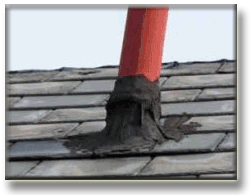
It is the constant peeve of the old world craftsman to see the new crop of novices every year that crawl upon good and sound repairable roofs and slather them with roof cement and caulk. It would provide some solace if these efforts worked to cure leaking situations on these natural roofs of old.
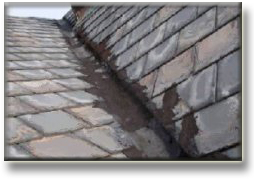
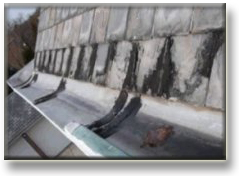
The truth is what we know as “muck” can actually cause a simple leak to become many profusely squirting leaks. Especially if used in a valley where water velocity demands a clear path. Muck creates obstacles for the water flow.
So instead, within the subject roof’s open valleys where a flowing stream should be, a run of raging rapids appear upon a subsequent rain event, squirting water under the courses laterally to enter the living area in several places. The muck dries and creates fissures that sends water in all directions. Like your finger on the end of a water hose, water sprays everywhere.
Slate, Tile and Cedar roofs are not that complex to understand. Cedar roofing has its own set of issues with new growth vs. old growth and repairs are more often than not out of the question. More on this will be discussed in future postings. Dismantling the natural stone and tile roofing is fairly easy to comprehend, but certain scaffolding and retrofitting skill is necessary.
Metal valleys that are leaking usually need to be replaced. If a slate roof still has life, replacing a valley is routine for a professional. Tile roofs often require the same attention. Tile roofs will last the longest of all the sloped systems. Tile was made from terra-cotta, ceramic and even concrete. All last a very long time, outlasting the flashings and valley linings.
The metal was often terne coated steel and sometimes copper. The latter was more expensive, but also vulnerable to the sulfur laden anthracite coal soot. The steel lasted longer then copper in some cases. The environment really dictated the longevity of the flashings. Note: We will be posting information regarding copper and cedar roofing (We did post a page with information regarding the improper use of copper flashings on cedar roofs and the damaging effects of cedar run-off acids on copper flashings.). We are noticing a trend where copper flashings are being used on cedar roofs - BIG NO NO. Old world craftsmen knew about this but many newcomers seem to be ignorant to the fact that cedar runoff degrades copper. We do have information on our website regarding this issue.
Nails were copper, tin, coated steel and galvanized steel. Often the nails falter first and looking across the courses will usually give us a good idea as to the holding power of the original nails. Generally, the weight of the tile and slate roofs put a burden on the nails and when the nails are deteriorating, they finally break away at the stress. The heavy stone or tile will sag at the course lines. If the courses are sagging, the nails are giving way and the roof needs to be removed and reclaimed, if possible.
Yankee Gutters are often removed and plywood is used to cover them because of cost, in favor of a conventional gutter. This represents a real loss of historical architecture. The cost of relining a Yankee Gutter is a small price to pay for the value it will yield and the curb appeal the gutter and underlying cornice details deliver a constant historical and cultural statement to the community. These old systems are not something for the novice to maintain. Often they are destroyed by the application of muck to them and the surrounding roofing tiles or slates.
So the moral to the story is to make sure you choose a natural roofing expert to evaluate your roof. A professional will give you the right advice. ]]>Half Round Gutter is Truly Superior even in Ice & Snow
http://fourseasonsroofingandsiding.com/Roofing-Blog/index.php?entry=entry100218-171035
With all the ‘K’ Style that is sold as “seamless,” run off a coil and job formed in many colors, it seems like the best thing since sliced bread. Truth be known, the miters are seamed, the end caps are seamed and they always leak. The gutter is mounted onto the fascia at the eave and tight up to the roof. The gutters are aluminum and the expansion and contraction rates are fairly significant, while being fastened tight with no provision for thermal movement. These gutters are installed outside of the roof plane but become almost integral, when adverse weather hits. 'K'Style mounted tight with hidden vents
All sorts of gutter covers are sold, every one of which are expensive and inhibit or eliminate the function of the gutter. Water runs over the gutter when heavy rain accumulates on the roof and washes over the gutter cover and onto the ground. In the belly of the gutter is a layer of scum that builds and breaks down and dries in times of drought. This scum layer, after about 5 years needs to be cleaned out. Many of these gutter covers make it impossible to clean the gunk out of the bottom of the gutter. When the build-up becomes thicker than ¼” dry weather causes it to crack when the gutter flexes and the scum is hard. The broken material lining the bottom of the gutter will wash to the outlet when a good rain comes and the gutter will clog. Five years is about the life expectancy of the gutter cover systems’ so called “never clean your gutters again” claim.
If your building is a candidate, spend the money on copper half round gutters. Go to a 6” with 4” spouts. A 4” spout is harder to clog. If you have an under ground system, a basket strainer can be installed at the outlet. (Basket Strainer in a box gutter)
Half round gutters are self cleaning in many cases, but they have to be checked in areas where heavy fallen foliage accumulates on the roof. Cleaning is a snap as the gutter is open without hangers blocking the way to clean them. The copper prohibits the scum layer as microbial activity if killed by the copper. The copper is allowed to flex with the hanger systems. The joints are soldered tight (do not purchase the new ornate rubber sealed copper gutters – stay with old school).
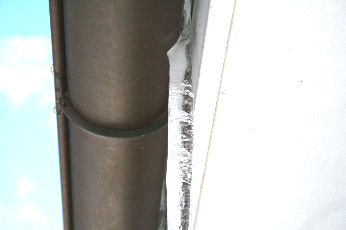
For the best property of half round gutter, look at the way they mount. They hang and are held away from the fascia and under the roof. When a major snow even comes or when the gutters may be clogged for any reason, the water is allowed to flow out and not into the eave of the building. Solid cornice is always the way to go and (silly) aluminum capping should never be considered. The solid cornice with the proper ventilation will allow a solid mount for the half round (if fascia mounts are used). The space between the gutter and the roof and fascia allows for ice blockages to melt and flow away. (Note: In the photos there are hidden intake vents on the edge of the roof)
The old ways are the best ways. It just makes sense. Another forgotten is the leader head. These were installed right below the gutter. Many “experts” think they are just for aesthetics, but they have purpose. They allow air into the spout so that water will flow and when ice is present, the added room for ice melting and movement keeps the spout from splitting from solid ice. These systems of old cannot be beat by anything in the modern arena. Adding more to the equation like gutter immovable covers will just mean more trouble later. (Leader Head provides air entry into system and allows ice to expand preventing splitting of downspout)
Galvanized is the most formidable and lasting, but the seams can be a maintenance problem. Aluminum is weak and dents easily when a ladder is put upon it. Copper lends a perception of lasting value and the changing patina keeps the look interesting. The protective patina usually takes ten years to develop. Copper that is shiny has a problem and is being degraded by another material of chemical or galvanic reaction. More on all of this can be found on our website.
Shiny Copper indicates erosion Thermal Movement Properties of commonly used metals]]>Seepage Leaks on Vertical Masonry & Sealing
http://fourseasonsroofingandsiding.com/Roofing-Blog/index.php?entry=entry100217-151753
We call them seepage leaks. We receive a multitude of calls when the weather is cold and the heat is on on the inside of homes. It seams that water flows toward the heat, soaks into masonry chimneys and walls and gravity pulls the water down to the points of entry in the building.
These leaks are completely and apart from any roofing issue, but the roofer will get the call. The point of entry always is near a roof juncture. We use the analogy that if you saturate a kitchen sponge and wring it out thoroughly and set it vertically on the counter, water will pond around the sponge on the counter.
This is essentially a valid analogy, but for the element of the heat and the pulling of the water inward. There is something to this effect. The general temperatures of occurrence of this type of leak is where the outside temperature is above freezing and the interior heat is turned on. A soaking rain or even a melting snow can cause this effect.
Sealing masonry is frowned upon by many in the industry, but an answer apart from a sealing of the vertical porous walls, cannot be found. Painting or sealing is the answer that will eliminate the seepage leaks on vertical walls. ]]>Ice Dam Prevention Starts With Understanding the Causes of the problem
http://fourseasonsroofingandsiding.com/Roofing-Blog/index.php?entry=entry100216-182714
The very first thing to consider once the damage is done and the work is being considered to repair the area is a provision for proper ventilation. The second thing to consider is better insulation for the attic space. If the roof is an asphalt roof, an ice & water underlayment can be installed but this is not the answer to preventing ice dams.
Why are ice dams more prevalent on asphalt shingle roofs?
A heavier roof like a slate or a tile roof will be more immune to serious ice dams because so called, “hot spots” are not a predominate issue. We use the analogy of a heavy cast iron cooking skillet as opposed to a thin pan set onto small burners. The thin metal pan will transfer the heat and burn in a small area while the heavier skillet will heat more uniformly and not have the “hot spot’ directly over the burner area. So this analogy is not a perfect one but the “hot spots’ on the roof tops are the number one cause of ice dams. Ice dams do form, however on these heavier roofs when there is significant snow and heat from the living area, combined with valleys or large areas of obstructed runoff.
Sometimes we have to resort to heat trace cables to do the job on older homes where providing the perfect intake and exhaust ventilation and insulation combination is not possible.
What happens when an ice dam occurs?
The sun plays a role in the melting of snow and along with interior heat from the attic, snow melts and the runoff is caught up on the cold eave of the roof. Like a bridge freezes before the road, the overhang stays frozen and the runoff builds on the roof edge. This situation continues to cycle and the dam that forms at the edge begins to rise up to a height that exceeds the slope of the roof. At this point, the melting water enters under the roofing and fed by the supply of roof runoff begins to run downward and entering the attic, capillary action begins to pull the water into the heated area. Water will run toward the heat, be propelled by the siphon feed and the damage can be devastating.
In creating the proper air flow under the roof deck, there will be less variation in the temperatures of different sections of roof. There will also be less disparity between the roof and the eave (that bridge that freezes first). Less irregular melting will occur with the proper ventilation. Proper ventilation also allows for exhaust in the upper area of the roof. A whole section on proper ventilation is available on our website.
In insulating the attic, the intake vents have to remain open. The uses of insulation baffles are good way to maintain the open eaves. The insulation job should be done so that any open chases where heated air can enter the attic are blocked tight first. Attic stairways are the biggest problem in air transfer from the living area to the attic. There are “tents” that are available to zipper seal the attic stairway tight. These procedures also cut down on the amount of moisture laden air that escapes to the attic to condense on the backside of the roof deck in the form of frost or water. A whole section of our website is available for more information on moisture and the “warm attic syndrome.”
Recommended ventilation rates are as follows: Sq ft of attic / 300 One sq ft of net free area per 300 sq. ft. of attic is recommended. This one sq. ft. should be divided by 2 for exhaust vs. intake. An excess in intake is always beneficial. A convective draw from the intake to the exhaust is best. A “wind tunnel” is not necessary. Just a fair amount of air movement is necessary. Note: Never mix exhaust vent types, e.g; Gable Vents, Ridge Vents, Power Vents, Passive Louvers, etc. This practice is very common and proper ventilation is probably the most misunderstood facet of the building industry.
Ventilation Presentation by AIR VENT ]]>Solar Panels - Solar Cells - installation - Bonding to Tile & Slate - Best System Application
http://fourseasonsroofingandsiding.com/Roofing-Blog/index.php?entry=entry100215-140308
With all these units a reasonable expectation of life cycle is within 20 – 25 years. Some companies are working on adhering tiles and slates with individual smaller sections that wire into the attic of homes. This is a viable way of making the units replaceable at a later date. It does shoot holes (literally) into the underlayment craze we find ourselves in these days.
The best method for installation is the standing seam clamp installation. This system allows for runoff under the panels and the clamp is positioned up on the seam of the panels. The worst application is of course, the screw-to-the asphalt shingle roof system where dams occur and related problems associated with surface mounting onto a roof where water velocity is a real problem. Raised mounting brackets show some promise in this regard.
It is essential that a quality roofer install these systems onto rooftops with the expressed intention that these systems are not permanent. The design should include expectation for removal of these systems for roof work under them and for the retrofitting of replacement units.
For a reasonable forward looking contractor, the slate and tile systems and the metal raised mounting seems to have the most potential. The tiles and slates can actually be aesthetically attractive systems as they are within the shingle or tile plane. No real obtrusive element to the systems exists, except for the color differences in the malleable panels that are adhered to the slates and tiles. The ease of making changes is attractive to the roofing contractor. Note: Image is from the "abcsolar.com" website]]>Underlayment Craze Causing Dew Points Within Walls
http://fourseasonsroofingandsiding.com/Roofing-Blog/index.php?entry=entry100214-145943
We have posted comments as to the causes for the development of these new underlayments as being the lower quality of the new primary products, or flaws in the systems employed and increased warranty demands. Some Sidings fully expected to leak are “flashed” with underlayments. This thinking is an affront to a old world installer of roofing and siding. We solicit the comments of installer professionals on this blog.
(Moisture caught behind house-wrap. Interior vapor barrier must equal exterior house-wrap that does act as a vapor barrier in cold weather)
]]>New Growth Wood - Accelerated Deterioration and Rot
http://fourseasonsroofingandsiding.com/Roofing-Blog/index.php?entry=entry100214-144747
We have seen accentuated rotting in wood construction materials. These are usually wood framed constructed homes dating back to approximately1988. Cedar Sidings and Roofing are almost always deteriorated beyond viability (with some exception to be discussed further). The quality of lumber has diminished considerably in the latter days of the twentieth century. We are soliciting industry professionals to post here so that we can do more than speculate, as the lumber industry has a tight lid on the causes of what we are seeing in the field. (20 yr. old cedar siding, circa 1988 - on the wall too long) (New Growth Cedar Siding - common late 1980's)
This type of siding used to last for a very long time, even known to be in service after 100 yrs. New growth fails in 15 years. ]]>
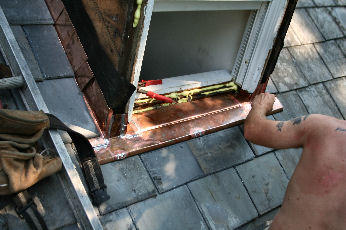 Natural roofing like that of Slate, Tile, Cedar, Metal and the like require abilities rarely fostered in the new age asphalt shingle and low slope marketplace. When a painfully under-skilled roofer endeavors to repair the natural roofing mentioned, the result is often destruction and higher end result costs to properly repair. Call a professional at FSI Restoration for a no-hassle report on your roof.
;)
;)

;)
 If you have, you must realize that when the pressure is utilized on a prospective client, it is actually a sign of weakness on the part of the salesperson. The high pressure tactics are covering weaknesses in the company represented.
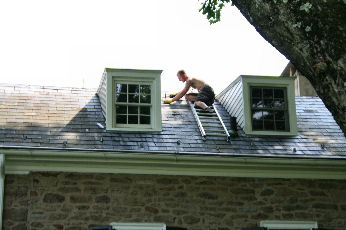 Every type of roofing, other than the ladder and common tools needed for service, requires different procedures and equipment to render lasting repair. Experience in management of a roofing company is essential for the facilitation of proper repair of all types of roofing.
 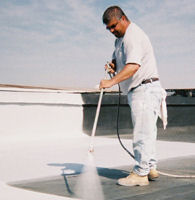 Usually a roofing company that services our area is more proficient in one area of roofing or another. The first and main distinguishing factor in proficiency in types of roofing is in that of the category of either steep or low sloped systems. In these two categories, while several methods are similar, methodology, materials and approach differ significantly.
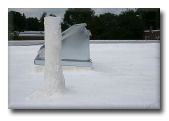 Many times when a roof is warranted for a period of time, its life can be extended to double of that warranty with the proper servicing of the rooftop. Even dried-out rooftops can be brought back into service with new elastomeric coatings available to the industry. Roof coating in Philadelphia is a thriving business as it is relatively inexpensive and it represents true value.
 .jpg)
;)
;)
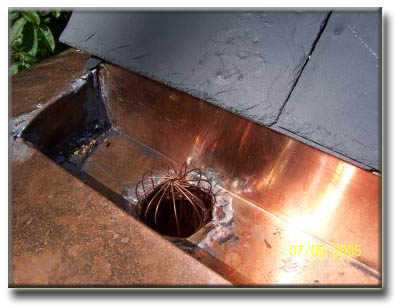 (Basket Strainer in a box gutter)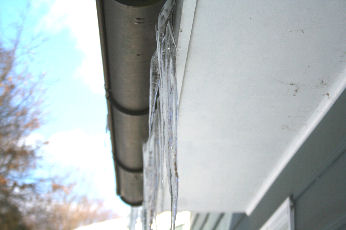
;)
;)
;)
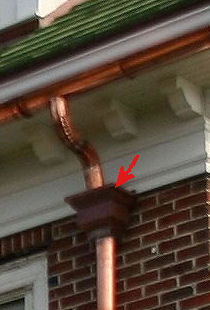 (Leader Head provides air entry into system and allows ice to expand preventing splitting of downspout)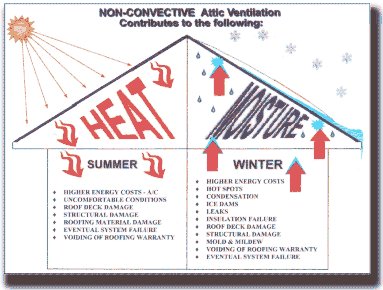

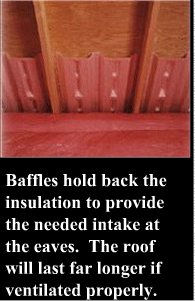
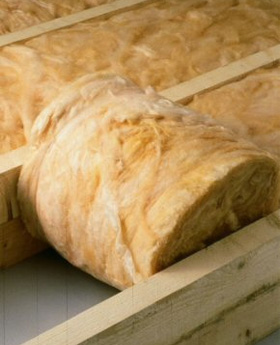
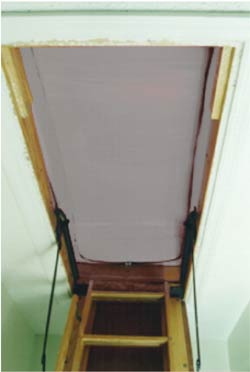 The insulation job should be done so that any open chases where heated air can enter the attic are blocked tight first. Attic stairways are the biggest problem in air transfer from the living area to the attic. There are “tents” that are available to zipper seal the attic stairway tight. These procedures also cut down on the amount of moisture laden air that escapes to the attic to condense on the backside of the roof deck in the form of frost or water. A whole section of our website is available for more information on moisture and the “warm attic syndrome.”
 ;)
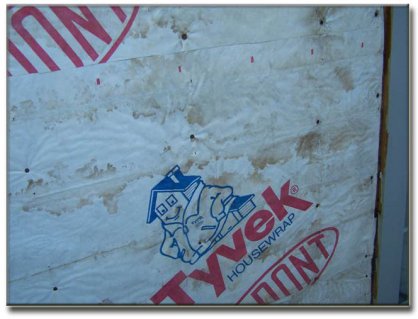 (Moisture caught behind house-wrap. Interior vapor barrier must equal exterior house-wrap that does act as a vapor barrier in cold weather)
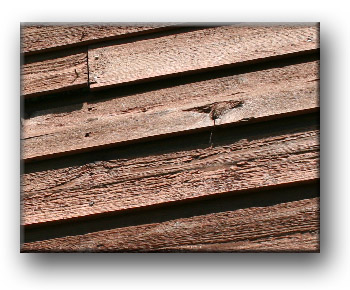 (20 yr. old cedar siding, circa 1988 - on the wall too long)
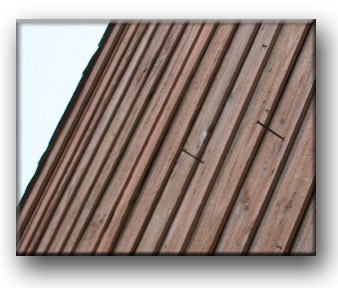 (New Growth Cedar Siding - common late 1980's)