Do not be fooled by "LIFETIME WARRANTIES"
Fiberglass
Roofing - Shingled Roofs Must Be Ventilated Properly The fiberglass base shingles of today are especially susceptible
to heat degradation. Most Roofers do offer a Ridge Vent on every
steep sloped roof, regardless of the existing situation. This is done to address a serious concern, but the measures that are being
employed everyday usually produce an imbalance in ventilation. Nothing could be more ridiculous and potentially harmful than this approach.
The thinking is that hot air rises and it will eventually leave the attic when the roof heats up enough to facilitate the relief
of this heat pressure. This is known as thermal buoyancy. The roofers
of old used this narrow approach and it used to be adequate several decades ago. Today the mere reliance on thermal buoyancy is no longer
adequate and manufacturer warranties are commonly voided because of lack of proper ventilation. Homes have changed and are now tighter than they have ever been. The roofing shingles of today are made
up of only one type of asphalt adhered to a stronger, yet more brittle reinforcement.
Please
ask your field estimator about shingle failures and voided warranties.
No matter how strong the warranty seems, there are caveats for inadequate ventilation. What
is adequate ventilation? Start to answer this by reading the fine
print in the warranty.
More important of a ventilation concern, is the control of desease causing attic mold. Attic mold remediation is just part of the solution to attic mold problems. Moisture control involves ventilation but only after examination by an expert in interior moisture and mold growth.
Below is a little history of the Asphalt Shingle Industry:
|
To
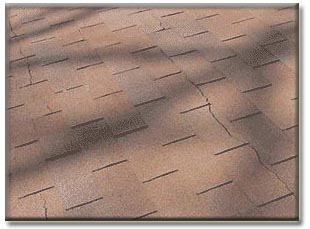
the left is a photograph of a roof that when taken,
was only seven years old. The three tab shingle
was rated and warranted for twenty five years. Lateral
cracking was caused by thermal shock from super
heating of the roof deck. The attic was improperly ventilated.
The
warranty coverage was voided because of poor ventilation. |
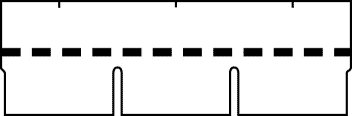 |
To
the left is a depiction of the basic 3 tab Asphalt
Roofing Shingle. |
Fiberglass
Based Shingles History
In the late 1970’s while the country was transfixed
on the long waiting lines for gasoline, and the
impending threat of being rationed petroleum, the
asphalt roofing shingle industry was in the midst
of radical change. Over the time period of about
five years, the northeast roofing shingle marketplace was dominated by the fiberglass roofing shingle.
This new breed of shingle was a much lighter and
seemingly a more uniform product. The major manufacturers
had made the big switch, it seemed overnight on
their basic three tab roofing shingle.
The
fiberglass base of the shingle was not organic,
would not rot, and did not have to be saturated
with a saturant asphalt, as did the old organic
paper mat base products. The production plants only
needed to apply an adherent asphalt to the mat and attach the granular surfacing and release material
and the lighter and purportedly better products
were ready for packaging. There was a savings on
the amount of asphalt used in manufacture, hence
it seemed even a patriotic effort, given the petrochemical and economic climate of the time.
Shortly
after the onset of these products, some of the downside
of the original design started to show itself in
the field. It was a decade of major improvement
that followed, compensating and improving in that
original product design. Some of the manufacturers touted better seal strips than had ever been seen
in the industry. Some of the manufacturers, like
Johns Manville, produced such a uniform product
that installers were thrilled at the increased ease
of production.
Back to Top
Overlays
with Fiberglass Shingles
Over
the top installations were affected drastically
as installers had to improperly nail (or “nail
high”) the product in order to recover roofs
without the old roof courses showing (or “telegraphing”)
through for a lumpy roof. “High nailing”
commonly caused blow-offs on over-the-top installations.
The increased heat retention of the overlays gave
the fiberglass based products their true field tests.
High heat seemed to degrade the fiberglass shingles
much faster than their organic, heavier, two step asphalt predecessors. The reasons were two fold.
The mat was more brittle and it was common to see
roofs crack laterally, as never seen before. The
adherent – only, more brittle, thinner shingle
was not as malleable, and therefore more susceptible
to thermal shock. The process of reformulating the
products continued. The asphalt mixes were improved
and stricter quality control standards were put
into place.
We
do not advocate reroof overlays - They do not last
- Flashings are ignored - They leak - Please ask
your estimator about this.
Laminated
Shingles
Laminated
Shingles like the GAF Timberline, Certainteed Landmark,
and others are a fantastic value. Improvements on
these products are ongoing, and they are better
now, in sevaral ways, than they have ever been.
In some ways, however, we have lost quality. The original ship-lap design provided a product that
was very uniform and when a roof was properly installed,
the completed roof looked uniform and the butt joints
were virtually invisible. A design was present that
provided a double layer over the nails and the shingles had to be installed in a set stagger system.
Again,
product “improvements” were made to
the original design. The fiberglass mat, asphalt,
and seal downs were upgraded. A company named ELK
started to produce a much more inexpensive laminated
roofing shingle that moved marginally through the
northeast market, and seemingly, at the time in the early 1980’s, made no real significant
impact on the industry. The manufacturing process
used by ELK was several times faster than the major
manufacturers' original hand-laminated offerings.
The price for the ELK products was significantly
less than that of the major manufacturers' products that included the shiplap and double coverage design
over critical areas. The big manufacturers, within
a decade, had changed over to a similar “In
Line Laminate Process,” similar to that originally
used by ELK. This process replaced the original
hand laminate process and the original ship-lap
laminated shingle design disappeared from the roofing
marketplace. With it, the uniform look of the laminated
roof also was lost. The impact on the laminated roof shingle design is that the butt joints are
random and steeper roofs will show the butt joints.
This concern leads some people away from the laminated
shingles on some jobs. The up side is that the improvements
have afforded the manufacturers the ability to rate the warranted life expectancy to double that of
the original products on the higher end laminates.
These products have become a real value in the asphalt
shingle industry. We do caution their use on some
high profile and steep roofs, however.
|
| To the right
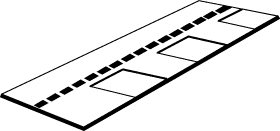
is a laminated two piece roofing shingle (GAF Timberline).
Below is the same shingle depicted at a different
angle. |
 |
|
| Above is a depiction of a two-piece laminate roofing
shingle. The black dashes represent the sealdowns.
The lap of the two layers is a 5/8" area that
extends up from the exposure line (just below the
black stripes) to the bottom of the black dashes.
The nails must be placed on a line that runs right
in the middle of the two. |
Laminated
Shingles on Steep Slopes
The two-piece
laminated shingles must be mechanically fastened
through the lap of both layers on steep sloped
applications. These shingles should also be double
nailed on steep slopes. The lap that must be penetrated
for proper mechanical fastening is only 5/8”
in width. This lap area in the design does not
give an adequate holding strength on many steep
sloped roofs. Steep roof applications should be
scrutinized before consideration of this type
of shingle. |
 |
Steep
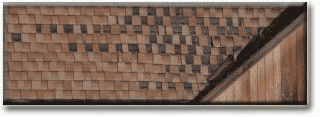
slopes are no place for architectural laminate shingles.
As you can see in the photographs, delaminating
can occur when the full weight of the lower laminated
double layer is suspended on the mechanical fasteners.
Mansards and steep sloped roofs should always be storm nailed (double nailed).
The argument
has been made for installer error in these situations,
but in defense of many installers, this shingle
design affords only a 5/8” overlap through
which a roofing nail is to be fastened. The laminate
bond alone will not hold the two piece shingle
together. Even double nailing is often not enough
to hold these shingles on steep slopes. The bottom
line……..Don’t use architectural
laminates on steep slopes.
Don't
just take our word - Read
the article in Pro Roofing Mag - written with kindly "Kid's
Gloves," but still very informing. Re: NAIL PLACEMENT ON LAMINATE SHINGLES
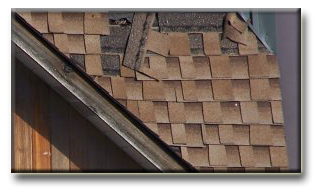
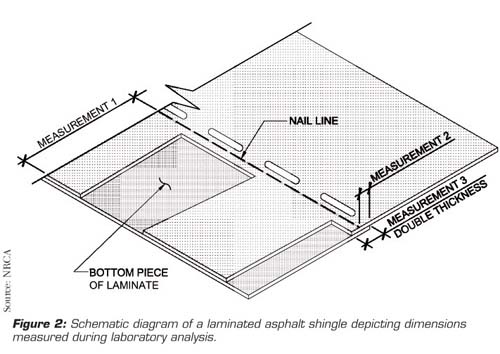
From
the above cited article: "For example,
NRCA has received a significant number of reports
about the bottommost pieces of some laminated asphalt
shingles loosening, becoming detached and falling
from roofs."
Designer
Shingles
There are designer products that are the best asphalt
shingles money can buy. These products are dual-laminated
and tri-laminated products. They are higher in price
than the laminated shingles, but they are uniform
and they have no two part base shingle design issues to consider in the fastening of the shingles. The
color patterns of the application of the granular
surfacing materials are computer enhanced to give
dramatic affects on several of the higher end products.
The shadow lines are engineered to complement the added bulk of the shingles. These products are usually
lifetime roofs and they are super-heavyweight products.
|
|


 VELUX Skylights

